You’ve found the house.
The location is right. The bedrooms work. You’ve already mentally positioned the sofa and decided which wall is getting painted first.
There’s just one problem.
You absolutely hate the kitchen.
Maybe it’s covered in dark wood. Perhaps it’s aggressively glossy. The worktops belong in another decade, the cupboard colour couldn’t be less you, and every time somebody says, “But it’s a really good kitchen!”, you have to resist the urge to scream.
And annoyingly… they’re probably right.
Because there’s a big difference between a bad kitchen and a kitchen that’s simply not your style.
If you’ve recently bought a home with a structurally sound kitchen that you don’t like, ripping everything out isn’t your only option.
A kitchen makeover can change the colour, finish and overall character of the room while retaining the parts that still work perfectly well.
And when you’ve just bought a property and seemingly every room wants a piece of your budget, that can make a lot of sense.
First Question: Do You Hate the Kitchen or Just How It Looks?
Before reaching for the sledgehammer, work out exactly what’s bothering you.
Is the layout terrible?
Are the cabinets damaged?
Is there nowhere to store anything?
Are the units genuinely at the end of their life?
If so, more extensive renovation may be justified.
But perhaps the problem is actually:
- Dark or dated cupboard doors
- A colour you wouldn’t have chosen
- Old-fashioned wood effects
- Glossy finishes
- Dated worktops
- Unfashionable handles
- A mismatched island
- An interior that doesn’t suit the rest of your home
Those are very different problems.
And many of them can be solved without replacing the entire kitchen.
Why This Happens So Often When Buying a House
Kitchens are personal.
One homeowner’s dream kitchen can be the next homeowner’s first renovation project.
The previous owners may have invested heavily in quality cabinetry, but if their taste was traditional dark oak and yours is light, warm and contemporary, that doesn’t make the kitchen poor quality.
It just means it was designed for somebody else.
This is particularly frustrating when you’ve bought a property with a relatively expensive kitchen.
Throwing perfectly good cabinetry into a skip simply because you dislike the finish can feel wasteful — especially when you’ve also got moving costs, decorating, furniture and approximately 900 other jobs competing for your money.
Instead, ask:
What would I think of this kitchen if it looked completely different?
If your answer is “I’d probably love it”, you’ve got a very good candidate for a makeover.
1. Change the Cabinet Colour and Change the Entire Room
Kitchen cabinets dominate the space visually.
That means changing their appearance can have an enormous impact without altering the layout at all.
Professional interior wrapping allows suitable existing doors, drawers, panels and cabinetry to be transformed using architectural films available in a wide variety of colours and textures.
A dark kitchen can become light and contemporary.
An old-fashioned wood finish can become a modern neutral.
A high-gloss kitchen can become beautifully matte.
Popular looks include:
- Cashmere and warm neutrals
- Contemporary greys
- Light woodgrains
- Natural oak effects
- Soft greens
- Matte black accents
- Stone-inspired finishes
- Clean, understated whites
You haven’t changed where a single cupboard sits.
Yet visually, it can feel like a completely different kitchen.
2. Replace the Doors Without Replacing the Cabinets
Sometimes the colour isn’t the only issue.
You might dislike the actual style of the doors.
Perhaps you’ve inherited heavily detailed traditional doors but want a cleaner contemporary design. Or the cabinet carcasses are excellent, while the doors have suffered more wear.
Replacement kitchen doors allow you to retain the existing cabinet framework while changing the visible fronts.
This can be particularly effective when you want to alter the character of the kitchen rather than simply its colour.
And it doesn’t have to be an either/or decision.
Replacement doors and professional wrapping can be combined where appropriate to create a coordinated kitchen makeover without a complete rip-out.
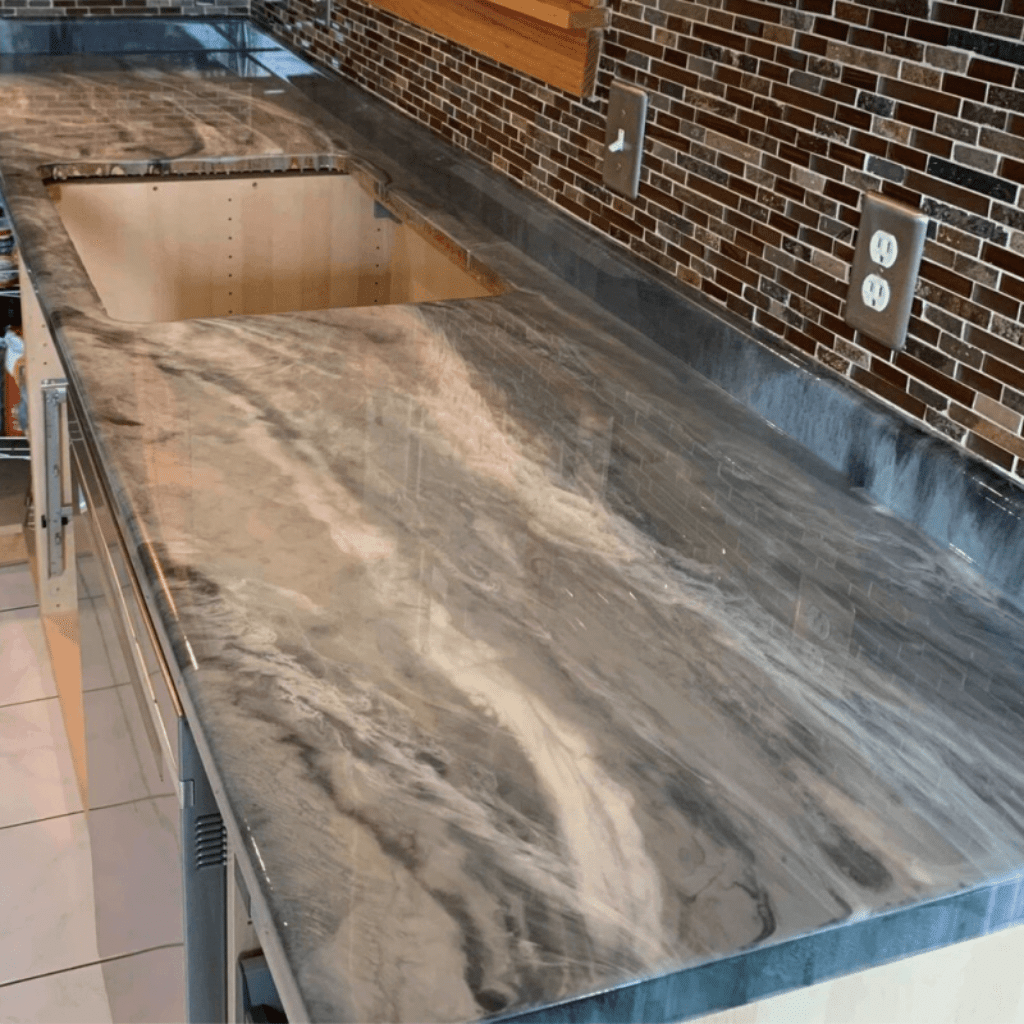
3. Don’t Let the Worktops Ruin Your New Look
Imagine transforming a dark kitchen into a beautiful contemporary neutral…
…and leaving the old speckled worktop sitting on top.
Sometimes it works.
Sometimes it very much does not.
Worktops have a huge influence on the overall appearance of a kitchen, so they should be considered at the same time as the cabinets.
Where suitable, existing worktops may be professionally wrapped in finishes inspired by:
- Marble
- Stone
- Concrete
- Slate
- Wood
- Contemporary solid surfaces
This gives you another opportunity to change the personality of the room without automatically replacing the existing worktops.
The important thing is to choose your cabinet and worktop finishes together, rather than treating them as completely separate decisions.
4. Give the Kitchen Island Its Own Personality
If your new kitchen has an island, you’ve got a brilliant opportunity to make the space feel more personal.
It doesn’t necessarily have to match every other cabinet.
A contrasting island can become the focal point of the kitchen.
For example, you could pair:
- Neutral cabinets with a darker island
- Light cabinetry with natural woodgrain
- Warm tones with a statement finish
- Simple cabinets with a stone-inspired feature
It’s an effective way to introduce character without overwhelming the entire room.
And suddenly the kitchen you inherited starts looking considerably more like the one you would have chosen yourself.
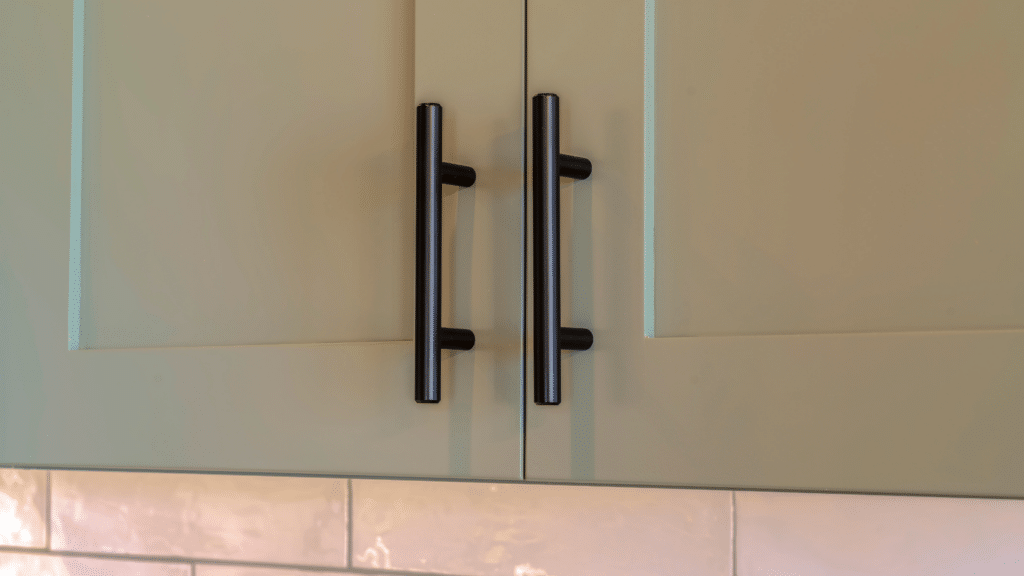
5. Change the Handles — Seriously
Handles seem insignificant until you change them.
Then you wonder why you didn’t do it sooner.
Older handles can instantly date otherwise good kitchen cabinetry.
Depending on the existing doors and fittings, updating the hardware can introduce:
- Matte black
- Brushed metal
- Contemporary bar handles
- Minimalist designs
- Warmer metallic finishes
When combined with new cabinet finishes, changing the handles can make the transformation feel much more complete.
It’s the kitchen equivalent of putting new shoes on an outfit.
Small detail. Big difference.
6. Work With the Flooring You Inherited
Here’s where planning matters.
When you’ve just moved house, you probably don’t want to replace absolutely everything simultaneously.
If the existing flooring is in good condition, use it as part of your makeover palette.
Look at its undertones.
Is it warm or cool?
Light or dark?
Busy or understated?
Then choose cabinet and worktop finishes that complement it.
This can save significant additional expense while helping the finished kitchen feel cohesive.
The same applies to existing wall colours, splashbacks and other features you intend to retain.
A good makeover works with the best parts of the room rather than fighting against them.
7. Spend Your Moving-In Budget Where It Actually Matters
Buying a house is expensive enough before you’ve changed anything.
Then suddenly you need:
- Curtains
- Furniture
- Paint
- Light fittings
- Garden equipment
- Storage
- Repairs
…and somehow seventeen trips to a DIY shop in the first fortnight.
Committing a huge proportion of your available budget to replacing a functional kitchen may not be your highest priority.
A makeover allows you to focus spending on the elements that will create the greatest visual improvement.
Perhaps the cabinets need transforming but the worktops are fine.
Maybe the doors need replacing but the units don’t.
Perhaps a complete change of finish plus new handles is enough.
There’s no rule saying every part of the kitchen has to be changed simply because one part doesn’t suit you.
8. Live With the Layout Before Changing It
This is a particularly important tip for new homeowners.
Unless the existing layout is obviously impractical, live with it for a while before making major structural changes.
You may discover that the kitchen actually functions brilliantly.
The person who designed it may have got the important things right:
- Storage
- Preparation space
- Appliance positions
- Movement around the room
- Seating
- Lighting
If you rip everything out immediately because you dislike the cabinet colour, you could end up spending thousands recreating almost exactly the same layout.
Give yourself time to separate how the kitchen works from how the kitchen looks.
You may realise the former doesn’t need changing at all.
Make the Kitchen Fit the Rest of Your New Home
Moving house often means gradually putting your own stamp on every room.
As the walls change colour, your furniture arrives and your own style begins to emerge, the inherited kitchen can start feeling even more disconnected.
A makeover gives you the opportunity to bring it into the same design language as the rest of the house.
If your home is becoming warm and natural, introduce complementary woodgrains and neutrals.
If you prefer contemporary minimalism, simplify the palette.
If you’re bold with colour, consider introducing a feature finish.
The goal isn’t necessarily to create the most fashionable kitchen.
It’s to create your kitchen.
Could a Kitchen Makeover Help Before You Fully Unpack?
There’s another advantage to planning early.
If you already know the kitchen needs changing, completing a makeover soon after moving can mean you start life in the property with the finished space you actually want.
Rather than filling every cupboard, settling in and then emptying everything again months later, it may make sense to investigate your options during the moving process.
The right timing will depend on your project, but it’s worth considering before the boxes completely take over.
A More Sustainable Way to Put Your Stamp on a Property
There’s also something slightly painful about seeing a high-quality kitchen thrown away purely because somebody dislikes its colour.
Retaining structurally sound cabinets can significantly reduce unnecessary material waste compared with complete replacement.
It’s a simple principle:
Keep what’s good. Transform what isn’t.
That doesn’t mean every kitchen should be saved.
Some genuinely need replacing.
But when the main problem is somebody else’s taste rather than the condition of the kitchen, refurbishment deserves serious consideration.
When Does a Kitchen Actually Need Replacing?
We’re big believers in makeovers, but we’re not going to pretend every kitchen can or should be retained.
A complete renovation may make more sense if:
- Cabinet carcasses are badly damaged
- Significant water damage is present
- The layout doesn’t function properly
- Major structural alterations are required
- Storage is completely inadequate
- The kitchen no longer meets the household’s needs
The goal shouldn’t be to avoid replacement at all costs.
It’s to avoid unnecessary replacement.
A professional assessment can help establish what is worth keeping and what genuinely needs changing.
Why Choose ReNewit for Your Kitchen Makeover?
At ReNewit, we specialise in helping homeowners look at existing interiors differently.
Rather than automatically assuming everything needs to come out, we assess what’s already there and explore what could be transformed.
Depending on the kitchen, makeover options can include:
- Professional kitchen wrapping
- Replacement kitchen doors
- Worktop transformations
- Cabinet and panel finishes
- Islands and feature areas
- Finishing details
Our Peterborough showroom also gives homeowners the opportunity to see and compare finishes in person before making their final choices.
Because when you’re turning somebody else’s kitchen into your kitchen, choosing the right combination matters.
FAQs
Can I change the look of a kitchen without replacing the cabinets?
Yes. If the existing cabinetry is structurally sound, professional wrapping, replacement doors, worktop transformations and hardware changes can dramatically alter its appearance without a complete replacement.
What should I change first in an inherited kitchen?
Start by identifying what you actually dislike. Cabinet colour, door style, worktops and handles are common visual issues. Understanding the problem first helps prevent unnecessary spending.
Can old kitchen cabinets be made to look modern?
Absolutely. Depending on their condition, older cabinets can often be transformed with contemporary colours, textures, replacement fronts and updated finishing details.
Should I renovate the kitchen immediately after buying a house?
Not necessarily. If you’re considering changing the layout, living with the kitchen first can help you understand how well it functions. If you’re only changing its appearance, however, completing the makeover before fully settling in may be convenient.
Can kitchen worktops be transformed without replacement?
Many suitable worktops can be professionally wrapped, although their material and condition need to be assessed first.
Is a kitchen makeover suitable before selling again?
A well-presented kitchen can improve the overall impression of a property. If you don’t intend to stay long term, a makeover may offer a more proportionate solution than investing in a complete new kitchen.
Bought the House? Now Make the Kitchen Yours.
You shouldn’t have to live with somebody else’s taste simply because the kitchen is “too good to rip out.”
And equally, you shouldn’t have to throw a perfectly functional kitchen away just to make your new house feel like home.
At ReNewit, we help homeowners transform existing kitchens through professional makeovers designed around the space they already have.
Bought a home with a kitchen that’s perfectly good but completely not you? Contact ReNewit or visit our Peterborough showroom and discover how we can turn the kitchen you inherited into one you’d actually choose.